Fabric, synthetic leather or wood: storing a dissection kit
In short
A suitable case organises clean, dry tools and protects delicate ends during transport. Materials differ in weight, bulk and care. Ordinary cases do not replace containers for contaminated instruments or unprotected sharps.
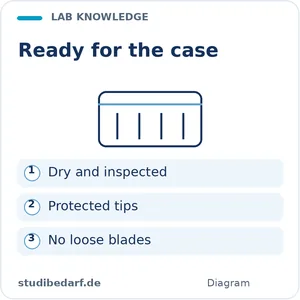
Fabric roll
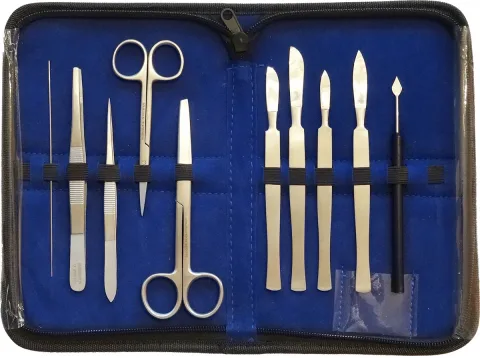
A roll packs compactly, often with individual pockets. Check that tips cannot pierce the material and tools remain secure. Washability depends on the complete construction.
Synthetic leather case
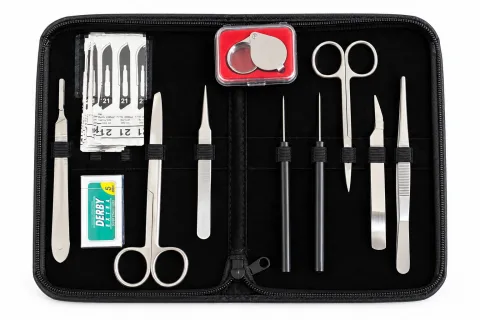
Zipped cases may use loops and compartments. Wipeable outer material does not mean all disinfectants are allowed: linings, seams and adhesives can be more sensitive. Velvet-style interiors especially need dry storage.
Wooden box
A rigid box may be attractive for organised long-term storage but usually weighs more and occupies more space. Wood and inserts have limits with moisture and chemicals. It is not automatically sterile or autoclavable.
| Criterion | Check |
|---|---|
| Daily transport | Weight, size, closure and secure retention. |
| Fine tips | Separate positions and suitable protection. |
| Care | All materials, not just the outside. |
| Organisation | Fixed positions and identification of your own kit. |
Before packing
Remove and dispose of used blades as instructed; complete the required care and drying; take damaged items out of use. An orderly case also makes the next completeness check easier.
Read care and disposal. Available variants appear with the kits.
Questions
- Can blades remain inside?
- Only with suitable protection and where local rules allow. No loose blades or uncovered cutting edges.
- Which material is most hygienic?
- Material alone cannot decide. Cleaning, drying and separation of clean and contaminated items matter.
Read next
 Cleaning, drying and storing dissecting instrumentsCare depends on the instrument, its use and its instructions. Plan contamination handling, appropriate clean …
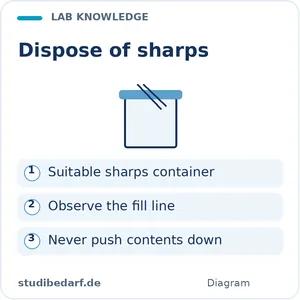 Disposing of scalpel blades and needles safelyPlace used blades, needles and comparable sharp items immediately into the appropriate designated sharps con …
General guidance for study and teaching. For your actual work, your safety briefing, hygiene plan, lab instructions and the product instructions apply. Legal information refers to Germany.