Anatomical, toothed and fine forceps: which type for which task?
In short
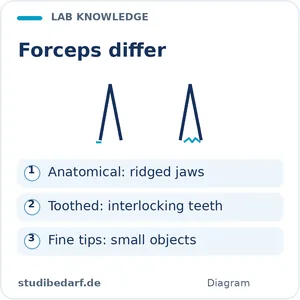
Anatomical forceps generally have ridged gripping surfaces without interlocking teeth. Surgical or toothed forceps have such teeth. Fine pointed forceps help handle very small structures. No type suits every specimen.
Contents
Anatomical forceps
Their ridged surfaces hold through pressure and surface texture. In teaching they often position tissue or specimens. “Anatomical” does not mean automatically gentle: excessive pressure still damages delicate structures. Tip width and spring force matter.
Toothed forceps
Interlocking teeth can hold firmer structures with less slipping, but create contact points that may damage thin membranes. Labels such as 1 × 2 often describe tooth arrangement; check the actual product and the manufacturer's notation.
Fine pointed and Feilchenfeld-type forceps
Slender tips help position small objects, for example plant parts under a lens. They are more vulnerable to impact and sideways bending. Length, fineness and curvature affect access and whether your hand blocks the view.
Curved tips can provide side access. Longer forceps increase hand-to-object distance but may feel less direct for very fine work. Choose for the task, rather than assuming sharper points are always better.
Check before use
- Tips meet evenly and accurately.
- Closing does not produce obvious sideways displacement.
- Ridges and teeth are intact.
- Spring force permits controlled handling.
- No burrs, corrosion or damage are present.
Do not casually bend fine tips back using another instrument. Alignment can worsen and material weaken; consider replacement or competent repair.
Read about kit selection, materials and hand lenses. Browse forceps.
Questions
- Can any forceps remove a blade?
- No. Use the method and aids specified for the scalpel system. Fine forceps may slip or become damaged.
- Can dissecting forceps be used on wounds?
- The shape name does not authorise patient care. Observe the manufacturer's intended use.
Read next
 Choosing a dissection kit for biology or medicineChoose the kit that matches your current course list. Biology practicals often emphasise small specimens and …
 Instrument materials: why can stainless steel corrode?Many dissecting instruments use stainless steel. Its corrosion resistance depends on a protective surface la …
 How to use a hand lens properlyHold a compact folding lens close to one eye and move the specimen until it appears sharp. Support your hand …
General guidance for study and teaching. For your actual work, your safety briefing, hygiene plan, lab instructions and the product instructions apply. Legal information refers to Germany.