
What equipment do medical students need?
In short
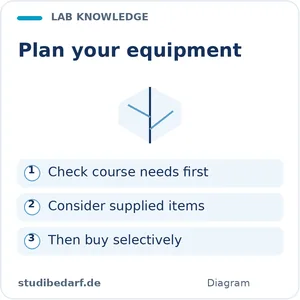
Buy for upcoming teaching: a coat and eyewear for science practicals, a suitable kit for anatomy, and a suitable stethoscope for examination classes. Not everything is needed on day one. Integrated or model curricula may introduce clinical work earlier.
Contents
Science practicals
Chemistry, biochemistry and related classes have their own lists and safety rules. Check coat and eye protection requirements, and select hand protection for the specific task. Group purchases still need individual fit.
Anatomy
Gross anatomy develops spatial understanding. Depending on the institute, equipment may include a specified scalpel system, forceps, scissors and probes. The Da Vinci kit with BAYHA is one possible combination to compare, not a blanket recommendation for every faculty.
Keep dissection-room equipment separate from later patient-contact equipment as local hygiene rules require. Used dissection tools do not belong in a coat pocket on a ward.
Examination courses
You learn communication and physical examination. A personal stethoscope may be expected; other instruments may be supplied. Select for audibility, fit, durability and cleaning. A basic flat-head model for blood-pressure exercises is not automatically ideal for learning differentiated heart and lung sounds.
Skills labs and suturing
Models and simulators support practical training. A suture pad or other training material can help supplementary practice if it matches the course. Training equipment must remain separate from clinical-use products. Do not practise needling or suturing on yourself or acquaintances.
Placements and practical year
Ask the host institution what clothing it supplies and which personal items are allowed. Do not buy specialist ward equipment solely from a generic online list. Clinical care requires suitable products, hygiene and responsible supervision.
Read about dissection classes, examination classes, stethoscopes and course equipment. Heidelberg and LMU provide examples; the older LMU document illustrates a format, not a current shopping list.
Questions
- Do I need an expensive stethoscope in semester one?
- Only if the curriculum requires one; the most expensive version is not a universal requirement. Suitable acoustic models serve many learning tasks.
- Do I need two coats?
- Separate areas may require or justify them. Check rather than wearing a contaminated coat everywhere.
Read next
 What happens in an anatomical dissection course?In Germany, “Präpkurs” usually means a gross-anatomy dissection class. Students learn structures and spatial …What is a U-Kurs in medical school?At German medical faculties, “U-Kurs” usually abbreviates Untersuchungskurs, a clinical examination course. …
 Stethoscope types: which is suitable for medical students?A well-made acoustic instrument with comfortable sealing earpieces and suitable sound performance is a usefu …
 Which products suit which university course?Match equipment to a class rather than a degree label. This table gives typical applications and shop starti …
Sources & further reading
General guidance for study and teaching. For your actual work, your safety briefing, hygiene plan, lab instructions and the product instructions apply. Legal information refers to Germany.
From our shop
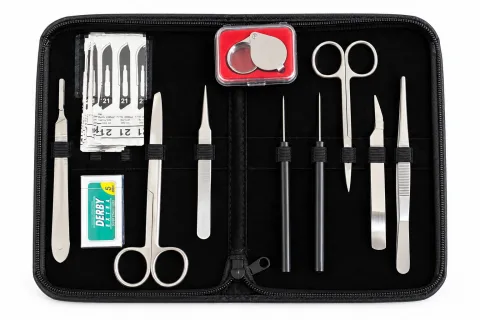 + Dissection Kit "Lorenz" for Biology
4,7 von 5 Sternen (78)
ab 22,99 €
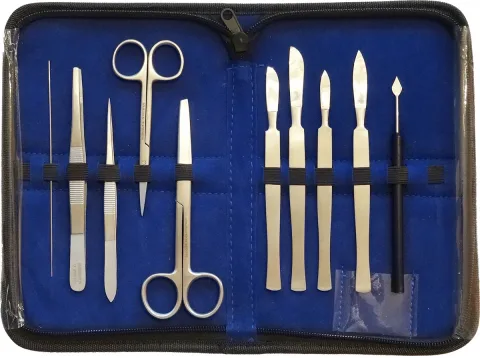 + Dissection Set "Paracelsus" with Fixed Blade Scalpels
4,6 von 5 Sternen (54)
ab 16,79 €
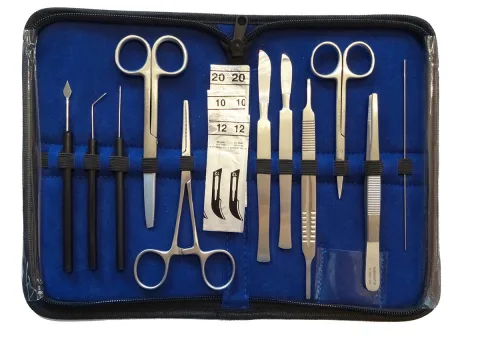 + Dissection Set "Hippocrates" with Fixed and Interchangeable Blade System
4,6 von 5 Sternen (54)
ab 19,29 €
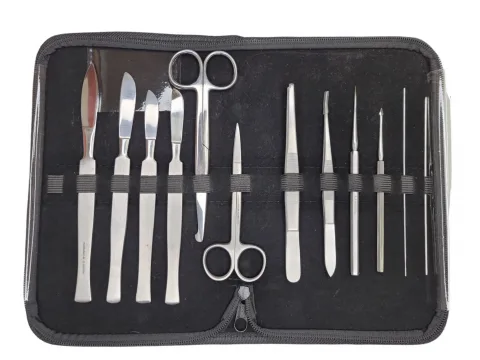 + Dissection Instruments "Harvey" for Medicine
4,7 von 5 Sternen (64)
ab 25,79 €