
What happens in an anatomical dissection course?
In short
In Germany, “Präpkurs” usually means a gross-anatomy dissection class. Students learn structures and spatial relationships under supervision, often through body donation. Timing, format and scope vary between faculties.

What you learn
A textbook separates structures clearly; in the body they are embedded in tissues and close neighbours. You connect names and functions with position: superficial versus deep, and structures running together. The goal is anatomical understanding, not cutting speed.
A possible teaching day
Prepare a region using the course script and atlas. An introduction or discussion precedes supervised group work. Teachers and student tutors help identify structures. Findings are discussed, and workspace and instruments are dealt with under institute rules. Oral checks or other assessments may be included.
This is a general picture: some programmes rely more on demonstration specimens, while others integrate dissection, imaging and digital learning.
Equipment
The institute's list governs. Common items include coat, suitable gloves, closed secure footwear and a specified kit. Check handles and replacement blades particularly carefully. Mechanical fit is insufficient if the system is not allowed locally.
Respect and personal preparation
Body donation makes this learning possible and requires respect. Photography, recording and personal devices are tightly regulated. Do not share names, circumstances or course information on social media without permission.
An emotional reaction or uncertainty at the first session is possible. Speak to staff early if uncomfortable; follow room rules and advice for feeling faint. Preparation and clear task allocation can make the introduction calmer.
Read about kit selection, blades and hygiene.
Questions
- Is it the same as an autopsy?
- No. Anatomical teaching and investigating a death have different main objectives; see autopsy versus dissection.
- Which semester?
- It varies. Heidelberg, for example, states the first semester for its gross-anatomy course; that is not universal.
Read next
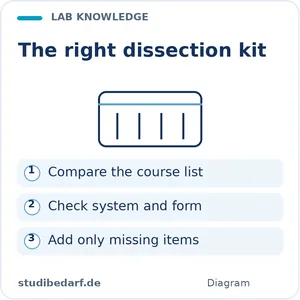 Choosing a dissection kit for biology or medicineChoose the kit that matches your current course list. Biology practicals often emphasise small specimens and …
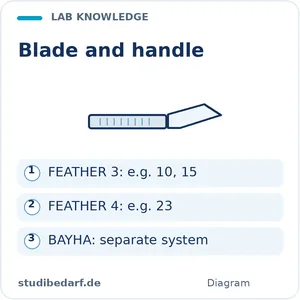 Which scalpel blade fits which handle?Compatibility depends on the blade system. Common fitting systems distinguish smaller and larger mounts, suc …
 Hygiene standards for coats, hands and instrumentsLaboratory hygiene combines organised work, appropriate hand hygiene, suitable clothing and defined procedur …
Sources & further reading
General guidance for study and teaching. For your actual work, your safety briefing, hygiene plan, lab instructions and the product instructions apply. Legal information refers to Germany.
From our shop
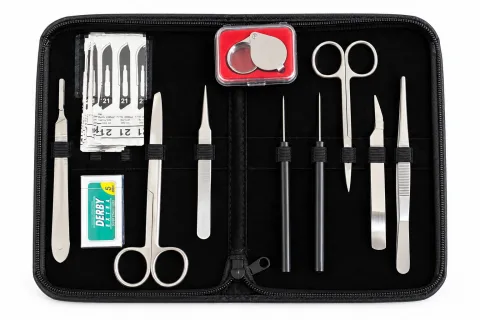 + Dissection Kit "Lorenz" for Biology
4,7 von 5 Sternen (78)
ab 22,99 €
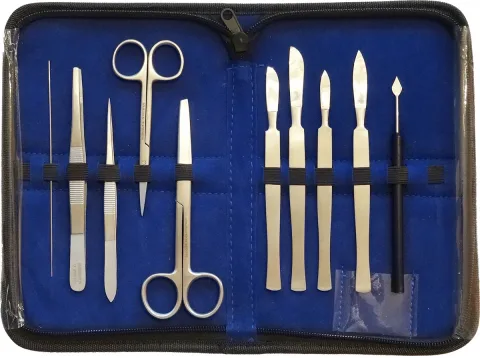 + Dissection Set "Paracelsus" with Fixed Blade Scalpels
4,6 von 5 Sternen (54)
ab 16,79 €
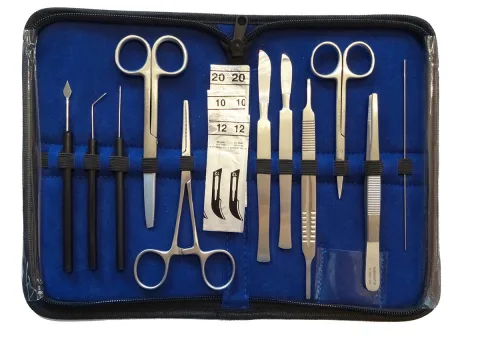 + Dissection Set "Hippocrates" with Fixed and Interchangeable Blade System
4,6 von 5 Sternen (54)
ab 19,29 €
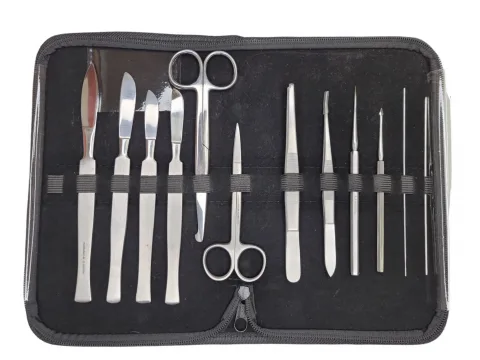 + Dissection Instruments "Harvey" for Medicine
4,7 von 5 Sternen (64)
ab 25,79 €