Why are lab coats usually white?
In short
White makes many stains easier to see and provides a neutral, recognisable work garment. It is also associated with cleanliness and medical or scientific work. White alone does not establish cleanliness or greater safety.

Visible dirt
Coloured splashes and residue often contrast with pale cloth, helping identify a need for replacement. This is only a visual aid. Colourless chemicals and many biological contaminants cannot be seen.
A bright-white coat may therefore still be unsuitable for another area. Previous use and the correct cleaning process matter.
Identification
Uniform clothing helps show who is dressed for a work area; names or logos can help further. That does not justify wearing it in public spaces. Cafeterias, libraries and travel require proper separation of work and private clothing.
Is white easier to wash?
Colour does not set care conditions. Cotton, blends and functional finishes differ. Even white garments cannot be bleached arbitrarily; closures, embroidery and prints may add restrictions.
Coloured coats
Institutions sometimes use colours to distinguish areas or roles. This is an organisational choice, not a universal rule. A coloured model is not automatically acceptable where a course expressly requires white.
Read cleaning, embroidery and hygiene. Browse coats.
Questions
- Why do white shades vary?
- Raw material, weave, finishing and batches may affect shade. A small difference does not itself establish poor quality or protection.
- Can I bleach stains?
- Only with appropriate material and care approval. Establish laboratory contamination before trying household products.
- Is white compulsory in every cleanroom?
- No. Cleanrooms have specific clothing systems; an ordinary white cotton coat is not automatically cleanroom clothing.
Read next
 Cleaning a lab coat: washing, stains and contaminationWhether you may wash a coat yourself depends first on how it was used and any possible contamination. A coat …
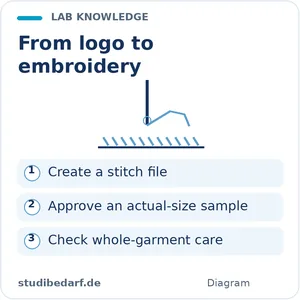 Embroidering lab coats: how direct embroidery worksDirect embroidery stitches a design into the coat using thread. A logo must first become a machine-readable …
 Hygiene standards for coats, hands and instrumentsLaboratory hygiene combines organised work, appropriate hand hygiene, suitable clothing and defined procedur …
General guidance for study and teaching. For your actual work, your safety briefing, hygiene plan, lab instructions and the product instructions apply. Legal information refers to Germany.