Embroidery, flocking, printing or heat transfer on lab coats?
In short
Direct embroidery is often useful for small logos on frequently used suitable coats. Printing and transfer can suit other designs or care conditions. “Only embroidery tolerates hot washing” is not a valid universal claim: the actual system and approval matter.
Contents
Flocking
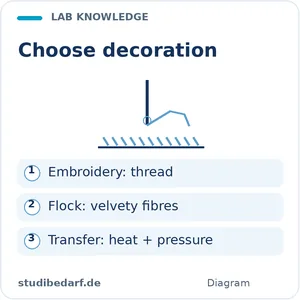
Short fibres create a velvety surface. Textile work can use cut flock-transfer materials with adhesive systems, although other flocking techniques exist. A soft finish may appeal for club or leisure wear. Laboratory clothing needs verified heat, chemical and abrasion compatibility.
Printing covers different techniques
Screen printing transfers ink through a prepared screen. Direct digital printing applies designs differently. Pretreatment, structure and curing vary. Appropriate printing can produce large coloured areas, gradients or pictures differently from stitched thread.
Heat transfer
A design is applied under suitable heat and pressure. Systems include flex films, flock transfers and printed transfer media. DTF transfers a prepared printed design with an adhesive system. “Transfer” is therefore not one quality or one washing temperature.
| Method | Typical strength | Check |
|---|---|---|
| Direct embroidery | Raised thread effect; often durable for small logos. | Size, thread, backing and garment function. |
| Flock | Soft textured surface. | The actual material's washing and chemical limits. |
| Screen/digital printing | Depending on method, large areas, detail or images. | Fabric, curing, care and print surface. |
| Transfer | Flexible designs, including small runs. | Adhesive, edges, stretch and care approval. |
Why embroidery often makes sense
A small properly stitched motif has no large continuous film whose edges might peel. Suitable thread can create robust identification, clearly visible on white fabric. However, needle holes remain and poor settings can pucker cloth. Very small text reaches practical limits sooner than digital artwork.
Start with the required care process
Ask about approval of the finished decorated garment, not just the unmodified coat. Siser, for example, specifies up to 60°C for StripFlock Pro; that says nothing about every other transfer. Likewise, heat-resistant thread does not approve the entire garment.
Read how embroidery works and hygiene. Request embroidery information.
Questions
- Is embroidery automatically more hygienic?
- No. Hygiene follows an appropriate cleaning procedure and suitability of the finished garment.
- What suits an institute logo?
- A clear direct embroidery often works if fabric, function and care allow. A suitable print may better suit photographic artwork.
Read next
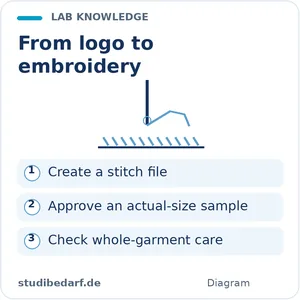 Embroidering lab coats: how direct embroidery worksDirect embroidery stitches a design into the coat using thread. A logo must first become a machine-readable …
 Hygiene standards for coats, hands and instrumentsLaboratory hygiene combines organised work, appropriate hand hygiene, suitable clothing and defined procedur …
Sources & further reading
General guidance for study and teaching. For your actual work, your safety briefing, hygiene plan, lab instructions and the product instructions apply. Legal information refers to Germany.